


The broadcasting industry is entering a defining era in 2026, shaped by rapid technological advancement and evolving audience behavior. Traditional broadcast models are giving way to flexible, digital-first ecosystems where speed, personalization, and immersive storytelling are essential. The biggest trends to watch cluster around cloud and IP transition, AI-assisted production, immersive interactive sports experiences, and heightened emphasis on sovereignty, resilience, and secure contribution distribution.
Broadcasters today are not just delivering content – they are crafting experiences that connect audiences across platforms, cultures, and devices in a highly competitive global media landscape. In this environment, countries that balance innovation with cultural identity are setting strong examples, demonstrating how modern broadcasting can evolve while preserving authenticity and trust.
1. Intelligent Production and Automation
Artificial intelligence and automation are taking over the center stage of a contemporary broadcasting workflow to change the way content is produced, handled, and distributed. Broadcasters are becoming more efficient and at the same time production high-quality with AI-assisted editing and real-time content tagging as well as automated scheduling and quality control. This development transcends the savings of cost, and it is a fundamental transformation to smarter and more adaptive operations that facilitate the faster turnaround times and the similarity of quality output across platforms. Live features based on AI are now transitioning to always-on operation, where real-time statistics overlays, dynamic player profiles, and AI predictions are now common features of the sports coverage and not an enhancement event, and production teams are automating the publishing and versioning processes to ensure that the content is ready to be broadcast on traditional TV and OTT platforms and social media with minimal human oversight. Meanwhile, the workflow orchestration and observability demand is also increasing so that broadcasters would be able to measure, monitor, and optimize processes at each level of production.
Multilingual content delivery, real-time subtitling, and advanced audience analytics, which are particularly essential in the area with diverse viewers, also become possible, which is facilitated by AI-powered tools. Strong institutional facilitation in the Middle East markets characterized by the critical role of media in cultural narration, and national growth is boosting the pace of adoption of the advanced technologies in promoting production quality without infringing the local values. Practically, AI has been used throughout the broadcast value chain in metadata creation, automated compliance testing, dynamic graphics, predictive audience analytics, intelligent scheduling, and efficient cross-platform content versioning, developing more efficient and fast workflows and producing richer and more personalized viewer experiences.
2. Cloud, IP, and Digital-First Broadcasting Models
Cloud-native and IP-based infrastructures are transforming how content is produced and distributed across the broadcasting ecosystem. These technologies offer unprecedented scalability, enable sophisticated remote production capabilities, and facilitate seamless collaboration across global and regional locations, empowering broadcasters to cover major events with greater agility and efficiency than ever before.
The shift in the infrastructure of traditional broadcasting to cloud and IP based systems is not a simple change in terms of technology. It essentially reinvents content production economics and potentialities. The broadcasters are now able to spin up production resources on need, cooperate across continents in real-time as well as scale operations dynamically in response to demand without huge capital commitments in the physical infrastructure.
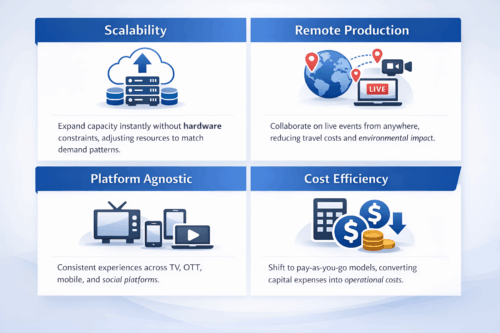
As audiences increasingly consume content via streaming platforms, mobile devices, and connected televisions, digital-first strategies are becoming the industry standard. Platform-agnostic broadcasting ensures consistent storytelling across traditional television, over-the-top services, and social media channels. In fast-developing media environments like Qatar, significant investments in digital infrastructure and smart city initiatives are further accelerating the adoption of cloud-based broadcasting solutions, supporting innovation while positioning the country as a regional media hub with global relevance.
3. Immersive, Personalized, and Audience-Centric Experiences
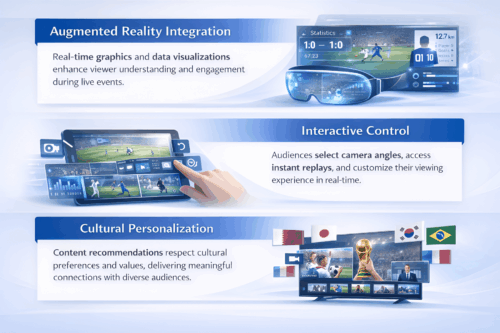
Audience expectations in 2026 are more dynamic and sophisticated than ever before. Viewers seek interactive, immersive, and personalized experiences that go beyond passive consumption – they want to participate, explore, and connect with content in meaningful ways. Technologies such as augmented reality, virtual production environments, and data-driven personalization engines are fundamentally redefining how stories are told and experienced.
Personalized content recommendations powered by machine learning, interactive live streams that respond to viewer input, and culturally resonant storytelling are strengthening audience engagement and building lasting loyalty. Broadcasters are increasingly focused on creating experiences that feel both technologically advanced and emotionally meaningful, ensuring content connects authentically with audiences across generations and cultural backgrounds.
Those that can succeed in this new world as a broadcaster will be those who realise that technology is a storytelling tool as opposed to the vice versa. Through innovations and the understanding of cultures and viewers, progressive media companies are developing experiences that are emotionally compelling as well as pushing the limits of what broadcasting is able to accomplish.
Shaping the Future of Broadcasting
The future of broadcasting in 2026 is defined by intelligence, flexibility, and meaningful engagement. Broadcasters who embrace automation, cloud technologies, and immersive experiences – while staying focused on authentic storytelling and genuine audience connection – will be best positioned to thrive in an increasingly competitive and fragmented media landscape. Success requires balancing technological innovation with cultural sensitivity, operational efficiency with creative excellence, and global capabilities with local relevance.
Within this rapidly evolving landscape, trusted technology partners play a vital role in enabling long-term growth and sustainable innovation. Technity Systems stands out through its strong commitment to supporting broadcasters with forward-thinking solutions, guided by a deep understanding of Qatar’s cultural values, media environment, and ambitious development goals.
By staying closely connected to the local market while embracing global broadcasting trends, Technity Systems continues to help media organizations evolve confidently, blending advanced technology with cultural awareness to shape the future of broadcasting in the region and beyond.

